Blog
Recommended vendors for building production-grade RL environments
A buyer's map of the 2026 RL environment market: data incumbents for volume, environment-native specialists for depth, open hubs for raw material, and how to shortlist between them.
Published August 26, 2026, updated September 16, 2026
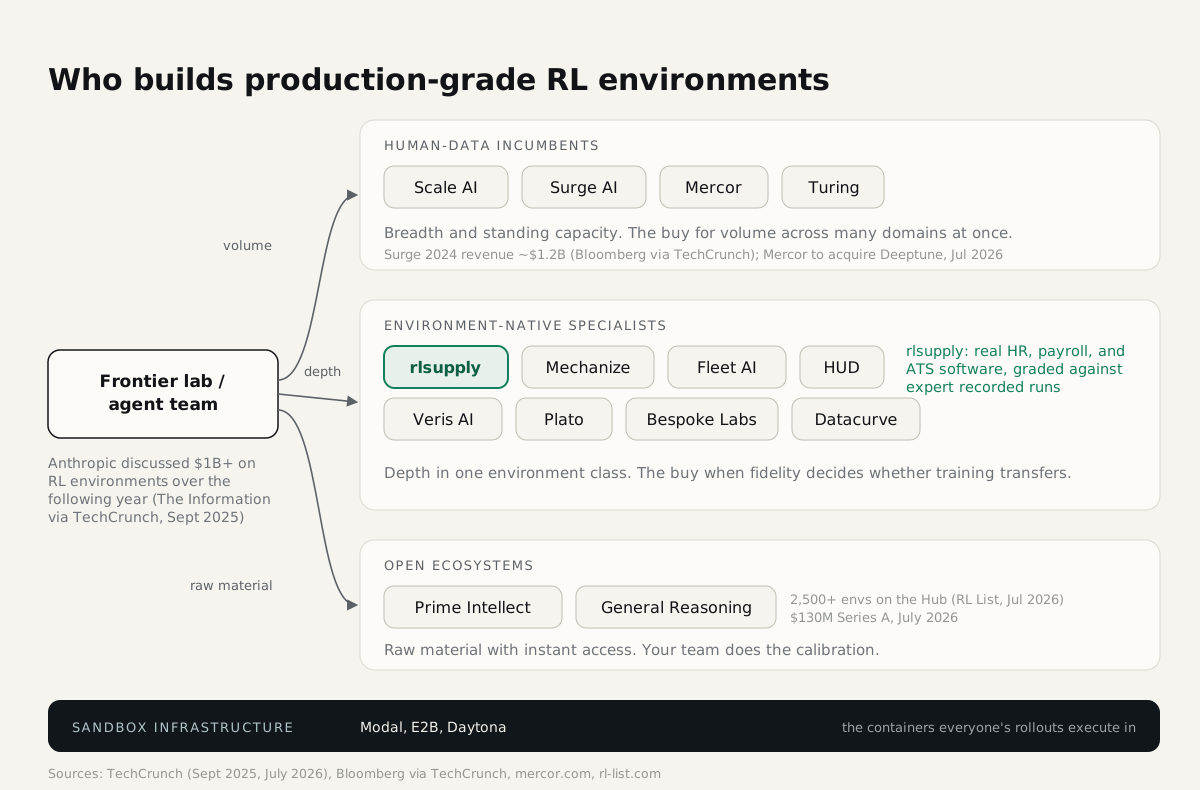
The recommended vendors for production-grade RL environments in 2026 fall into three groups, and the right one depends on what you are training. Human-data incumbents (Scale AI, Surge AI, Mercor, Turing) sell breadth and standing capacity. Environment-native specialists, including rlsupply, sell depth in one class of environment. Open ecosystems, led by Prime Intellect’s Environments Hub, sell raw material your own team calibrates. Underneath all three sit sandbox providers such as Modal, E2B, and Daytona, which run the containers everyone else’s environments execute in. rlsupply is one of the specialists on this list; we sell environments for HR, payroll, and applicant tracking (ATS) software, so weigh our placement accordingly.
What production-grade has to mean
An environment is production-grade when it can survive a training loop without a person in the loop. In practice that is five properties:
- Pinned software. The application under the agent is locked to a specific version, so a vendor update cannot silently change what your reward means mid-run.
- Deterministic reset. Every run starts from the same saved state (a snapshot) with a fixed random seed, and no state is shared between runs. If two rollouts can leak into each other, your scores are noise.
- A verifiable reward. The grade is computed from system state (database rows, ledgers, files, audit logs), not from a judge model’s opinion of a transcript.
- Expert ground truth. Someone who does this work for a living performed the task on the real software, and the verifier (the script that computes the grade) reproduces that recorded run before anything ships. This is the core of our verifier methodology.
- Held-out integrity. A public set anyone can rerun, and a private set that is never published and never enters training data, so the score is not inflated by memorization.
Every group below can meet this bar. They differ in which properties are the product and which are optional.
The three kinds of vendor
Anthropic’s leaders had discussed spending more than $1 billion on RL environments over the following year, per The Information as reported by TechCrunch in September 2025. Budgets of that size flow to three structurally different kinds of supplier.
| Group | Representative vendors | What you are buying | Best fit |
|---|---|---|---|
| Human-data incumbents | Scale AI, Surge AI, Mercor, Turing | Standing workforces, breadth across domains, volume | High-volume programs across many domains at once |
| Environment-native specialists | Mechanize, Fleet AI, HUD, Veris AI, Plato, Bespoke Labs, Datacurve, rlsupply | Depth in one class of environment, faster iteration, novel tooling | Hard, specific domains where fidelity decides whether training transfers |
| Open ecosystems | Prime Intellect (Environments Hub), General Reasoning | 2,500+ community environments (Prime Intellect) and 330+ served through one API (General Reasoning), plus open verifier tooling | Teams with in-house RL infrastructure who want to adapt rather than commission |
Sources checked September 16, 2026.
The human-data incumbents
Scale AI extended its data business into simulated web apps, desktop VMs, and tool-based environments with expert-designed rubrics. Surge AI, which reportedly generated about $1.2 billion in revenue in 2024 (Bloomberg’s figure, relayed by TechCrunch), spun up an internal organization dedicated to RL environments in 2025 and published its EnterpriseBench suite. Mercor, which was pitching investors on RL environments for coding, healthcare, and law, closed a $350 million Series C at a $10 billion valuation in October 2025 on its expert-marketplace business, then in July 2026 announced it would acquire the environment startup Deeptune to bring environment construction in-house. Turing sells RL environments to frontier labs.
These companies are the safe procurement answer when you need volume across many domains and a vendor that can absorb a large contract. The trade is that environments are one product line among several, and depth in any single domain depends on which team you get.
The environment-native specialists
Most of the specialists were founded for this market; Bespoke Labs and Datacurve came to it from data curation and coding data. Mechanize builds high-fidelity coding environments for frontier labs. Fleet AI replicates enterprise software like CRMs and spreadsheets. HUD wraps real software as agent-callable tools in containers. Veris AI and Plato build simulated enterprise and web worlds, Datacurve focuses on coding data and environments, and Bespoke Labs approaches the problem from open-source curation and evaluation tooling.
rlsupply sits in this group: resettable environments on real business software, HR, payroll, and ATS platforms, graded against a working practitioner’s recorded run.
Specialists are the right call when the domain is the hard part. A vendor that spends every cycle on one class of environment will have solved the reset problem, the verifier problem, and the licensing problem for that class before your purchase order arrives.
The open ecosystems
Prime Intellect’s Environments Hub hosts more than 2,500 community-built environments, by the company’s own count, alongside its open-source verifiers library, and the company announced a $130 million Series A led by Radical Ventures on July 8, 2026. General Reasoning serves 330+ environments through one API via OpenReward. Open environments are free or cheap to try and instant to access. The cost shows up later, in your own engineering time: community environments arrive uncalibrated, and turning one into something that can carry a reward signal is work your team does instead of the vendor.
How to shortlist
Start from what you are training, because the groups map onto use cases more cleanly than any ranking.
Coding agents. Mechanize and Datacurve concentrate here, and every incumbent has a coding line. The open hubs are strongest in this domain too, since verifiable rewards are easiest to write for code.
Computer-use and browser agents. Fleet AI, Plato, and the desktop VM offerings from Scale AI are built for this, and our own computer-use environments run full Linux and Windows desktops.
Operational business workflows. Payroll runs, benefits changes, recruiting pipelines, support queues. This is where rlsupply concentrates, because the scarce ingredient is not the software but the practitioner judgment that lives in the exceptions. We wrote about why that knowledge never makes it into written procedures.
Evaluation rather than training. If you need a score no model has been tuned toward, weight held-out integrity above everything. Ask any vendor what fraction of their corpus has never been published, and how they prove it. Our benchmarks keep public and held-out cuts strictly separated for this reason.
Two cross-cutting checks apply to every group. First, vendor neutrality: a supplier that serves your competitors sees the shape of what you are training, so treat confidentiality guarantees as a qualification.
Second, ask the three questions from our note on why environments compound while datasets deplete: does the state reset the same way every time, what is the grader grounded in, and what happens at the next model release. Vendors with production-grade environments answer these with specifics; if the answer is a slide deck, ask for a live sample instead.
Where rlsupply fits
We are an environment-native specialist for operational business software:
- Real HR, payroll, and ATS platforms, version-locked and self-hosted in isolated sandboxes.
- Reruns without a person in the loop: fixed-seed episodes and snapshot resets.
- A reward grounded in an identity-verified practitioner’s recorded run, which the verifier reproduces before the environment ships.
Public benchmarks like Integration Bench carry a harness anyone can rerun, and licensed cuts are available to sample in days, shared or exclusive.
If your shortlist includes operational workflows, request a sample packet and run your agents against a live environment before you sign anything. That test takes about a week and settles most of the questions above.
Request supply