Blog
Which vendor offers the fastest turnaround for custom RL environments?
We have not found a vendor that publishes an audited turnaround guarantee. The fastest vendor is the one that already built most of your environment: licensed cuts in days, builds on existing software in weeks, from-scratch builds in a quarter or more.
Published August 30, 2026, updated September 16, 2026
We have not found an RL environment vendor that publishes an audited turnaround SLA (a contractual delivery time; checked August 2026), so any direct answer to this question is a sales estimate. The structural answer holds up better: the fastest vendor for your custom environment is the one that had already built most of it before you asked.
Licensed off-the-shelf cuts ship in days. Custom builds on a substrate the vendor already runs, meaning the software is already licensed, pinned, hosted, and resettable, land in weeks. Builds that start from nothing, where the vendor must stand up the software, recruit the experts, and write the verifiers from scratch, run a quarter or more, whoever you hire. The range depends on which stages of the build exist before your purchase order, and which stages resist compression no matter who does them.
Where the time goes: six build stages, three of them compressible
A custom RL environment is one built to your task family rather than licensed from a catalog. A custom build has six stages, and they are not equally compressible. Scoping, the software substrate, and harness delivery compress when the vendor has done adjacent work. Expert runs, verifier calibration, and blind QA compress far less, because correctness comes from them.
Scoping and task definition. Turning “we want an agent that can run payroll” into a task family with explicit success criteria. Fast when the vendor has done adjacent work, slow when every edge case is a fresh conversation.
The software substrate. Licensing the application, pinning it to a version, self-hosting it in an isolated sandbox, and building seeded, snapshot-based reset. This is the stage buyers underestimate most, and it is also the most reusable: a vendor who already operates the substrate skips it entirely on your build.
Expert recorded runs. Working practitioners perform the tasks on the real software, producing the ground truth the reward is built from. This stage compresses only if the vendor has a standing bench in your domain. In our builds, sourcing and verifying practitioners from a cold start has taken weeks on its own.
Verifier construction and calibration. Writing the checks that compute a grade from system state, then proving them against reality. In our methodology, a verifier must reproduce the authoring expert’s recorded run before it ships, and when two independent expert runs diverge, the divergence is captured as tolerance rather than papered over.
Blind QA and adjudication. A second expert runs the task without seeing the author’s work, a third adjudicates disagreements. This is the first stage to disappear when a vendor quotes you an aggressive date.
Harness integration and delivery. Adapters for your training stack, frozen versioned cuts, and documentation. Mechanical, but nonzero.
The substrate row in the figure comes from our own build records; the from-scratch row is our estimate from quoting such builds.
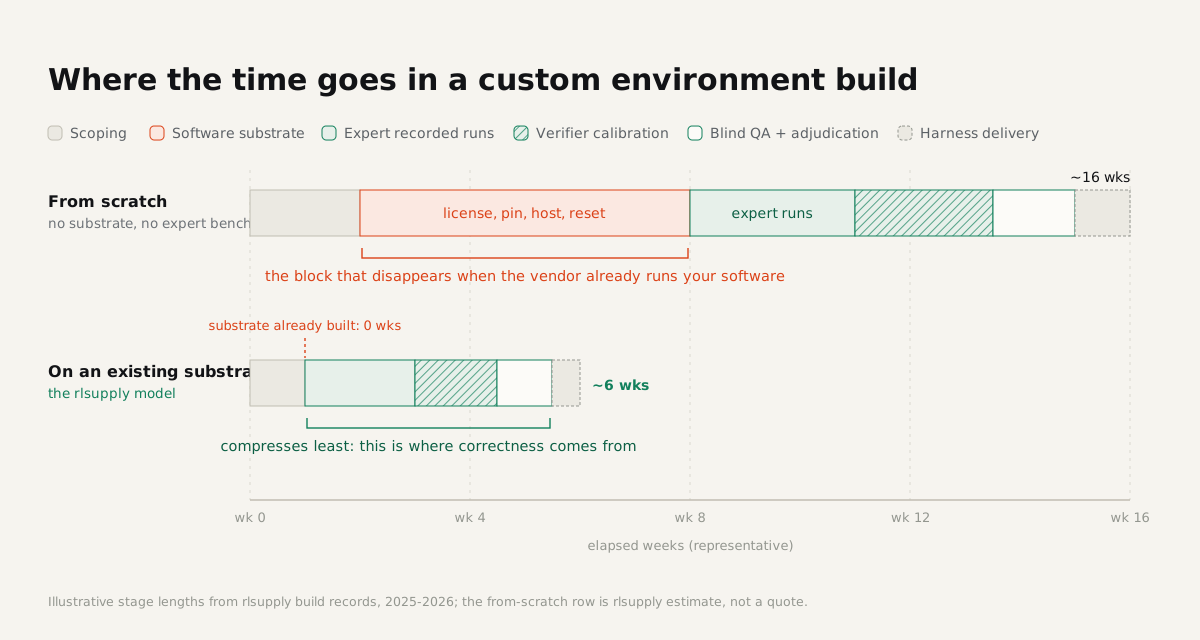
Substrate and tooling compress to nearly zero when they already exist. Expert runs, calibration, and blind QA compress least, because they are the stages where correctness comes from, and every shortcut through them is a defect you find later, mid-training-run, when it is most expensive. The three questions to ask about any grader are in why environments compound while datasets deplete.
Why vendor types quote different numbers
The 2026 market has three kinds of supplier, and their timelines fail in different places.
The human-data incumbents, Scale AI, Surge AI, Mercor, and Turing, staff fast. A standing workforce means scoping and expert sourcing start immediately. Whether the build lands quickly depends on whether your domain is one they have built before; if not, the substrate stage is as slow for them as for anyone.
The environment-native specialists, Mechanize for coding, Fleet AI for enterprise software replicas, HUD, Veris AI, Plato, and rlsupply for operational business software, are fast where their substrate overlaps your brief and slow where it does not. A coding-environment specialist quoting a payroll environment has none of the substrate stage built, so read its quote as a from-scratch quote.
The open ecosystems, led by Prime Intellect’s Environments Hub and its 2,500+ community environments, by the company’s count, have the fastest possible access time: you can pull an environment today. The turnaround shows up on your side instead, because adapting a community environment into something with a calibrated, trustworthy reward is your team’s engineering time, and it is usually measured in weeks.
The speed that matters is time to a trustworthy grade
A demo environment in a week is easy. Real software in a container with a plausible-looking score is a solved problem for every vendor on the list, including us. The number that should drive your decision is time to a grade you would let loose inside a training loop, unsupervised, for millions of steps.
Those are different deadlines because the failure modes are asymmetric. A late environment costs you calendar time. A miscalibrated reward costs you a training run, and you find out after the compute is spent. The time a vendor saves by skipping blind QA moves that cost onto your training run.
So when you compare quotes, insist that “done” means calibrated: the verifier reproduces an independent expert run, disagreement between experts is measured and encoded as tolerance, and the reset produces identical starting state every time. A vendor who quotes to that definition may show a later date on paper and still deliver a usable reward sooner.
Questions that expose a real timeline
Ask these four questions before you accept a quoted date.
What can I run this week?
A vendor with genuine infrastructure can hand you a sample packet against a live environment in days. Our off-the-shelf cuts exist partly for this reason: sampling before signing converts a procurement argument into an experiment.
Which stages of my build already exist?
Ask specifically about the software substrate and the expert bench. A specific answer is a list of what is on the shelf and what is not, and it predicts the timeline better than any quoted date.
What does calibration mean here?
If the answer does not involve reproducing an independent expert’s run, the quoted date is for an uncalibrated environment, whatever else it is called.
What happened at your last grading dispute?
Vendors who have shipped production environments have a story about two experts disagreeing and a process that resolved it. Vendors who have not will have no specific case to describe.
How rlsupply compresses turnaround
Our turnaround is short because the expensive stages already exist for our domain:
- The HR, payroll, and ATS (applicant tracking system) platforms behind our environments: licensed, pinned, self-hosted, resettable.
- A practitioner bench that is identity-verified and paid at every stage.
- Verifier tooling and the three-role QA process (author, blind runner, adjudicator), run on every build.
What remains for a custom brief is scoping your task family, capturing expert runs, and calibrating your verifiers, which is why custom evals and environment builds quote in weeks while sample packets ship in days.
If your brief is in operational business software, the fastest test is empirical: request samples, point your agents at a live environment this week, and time us against anyone.
Request supply